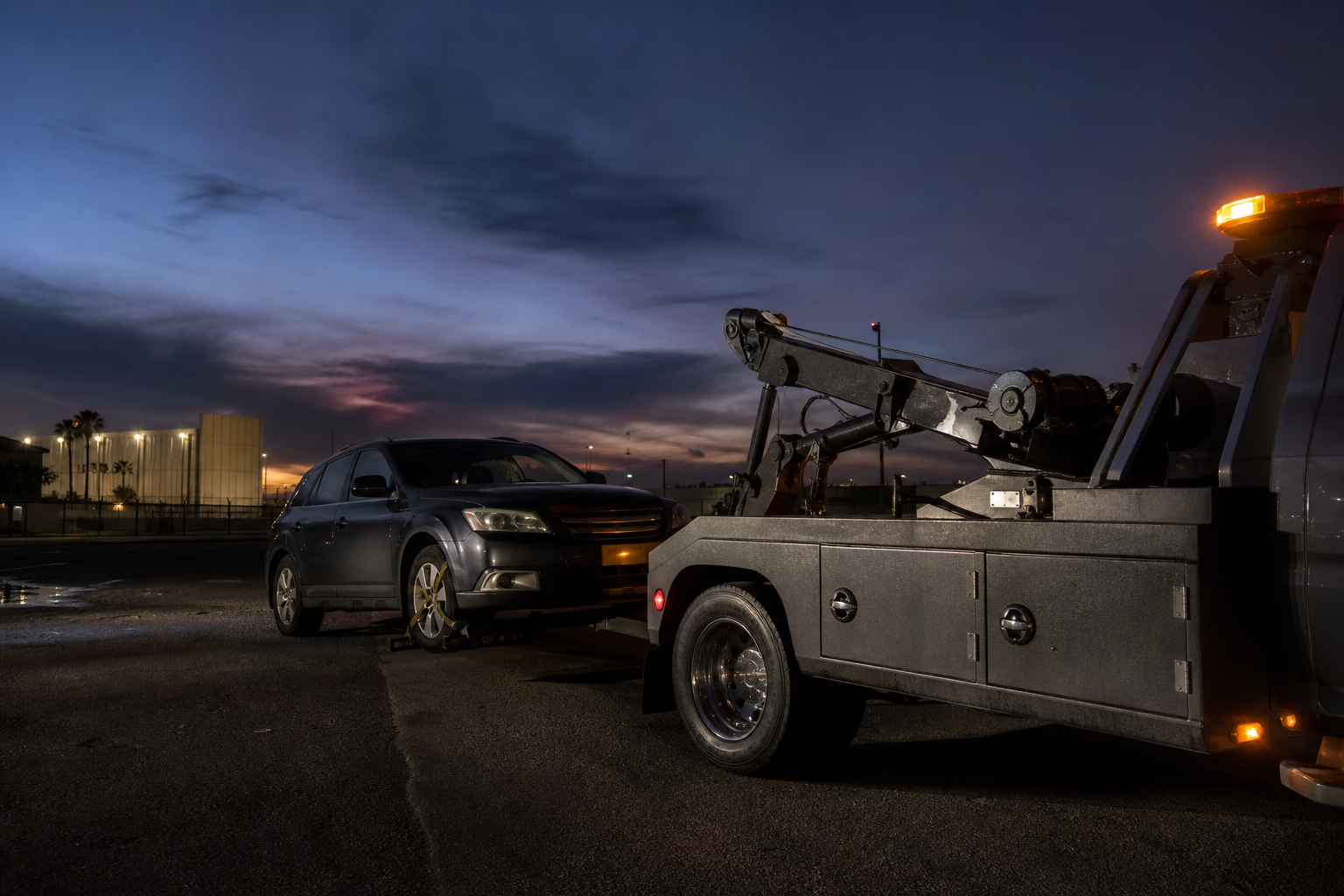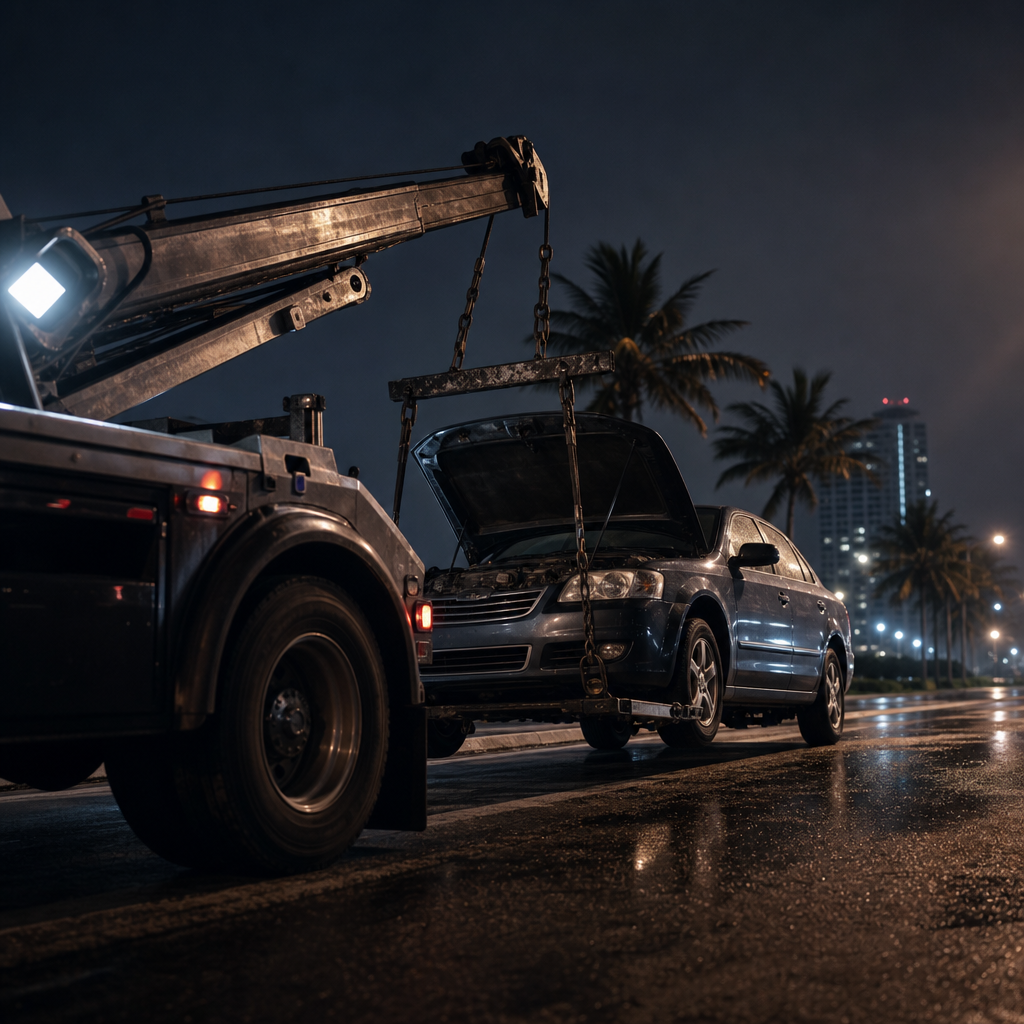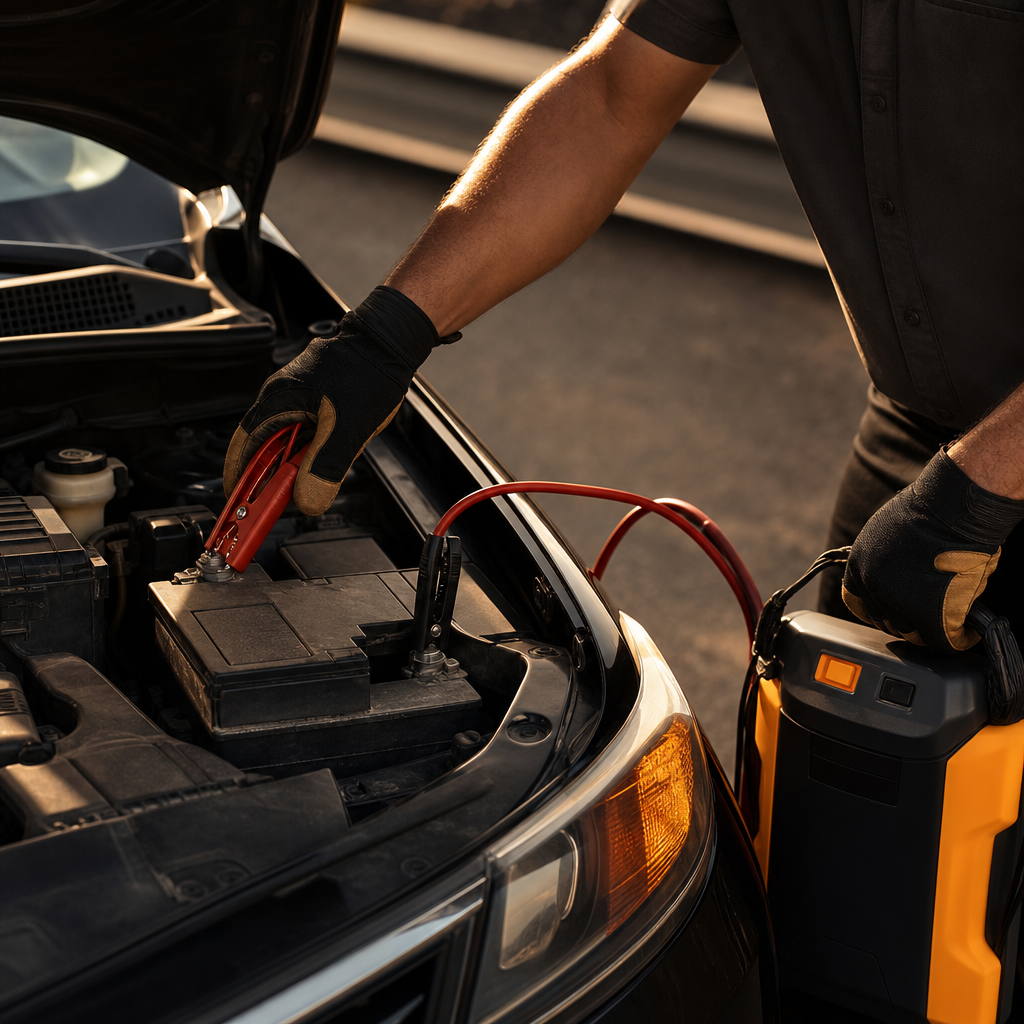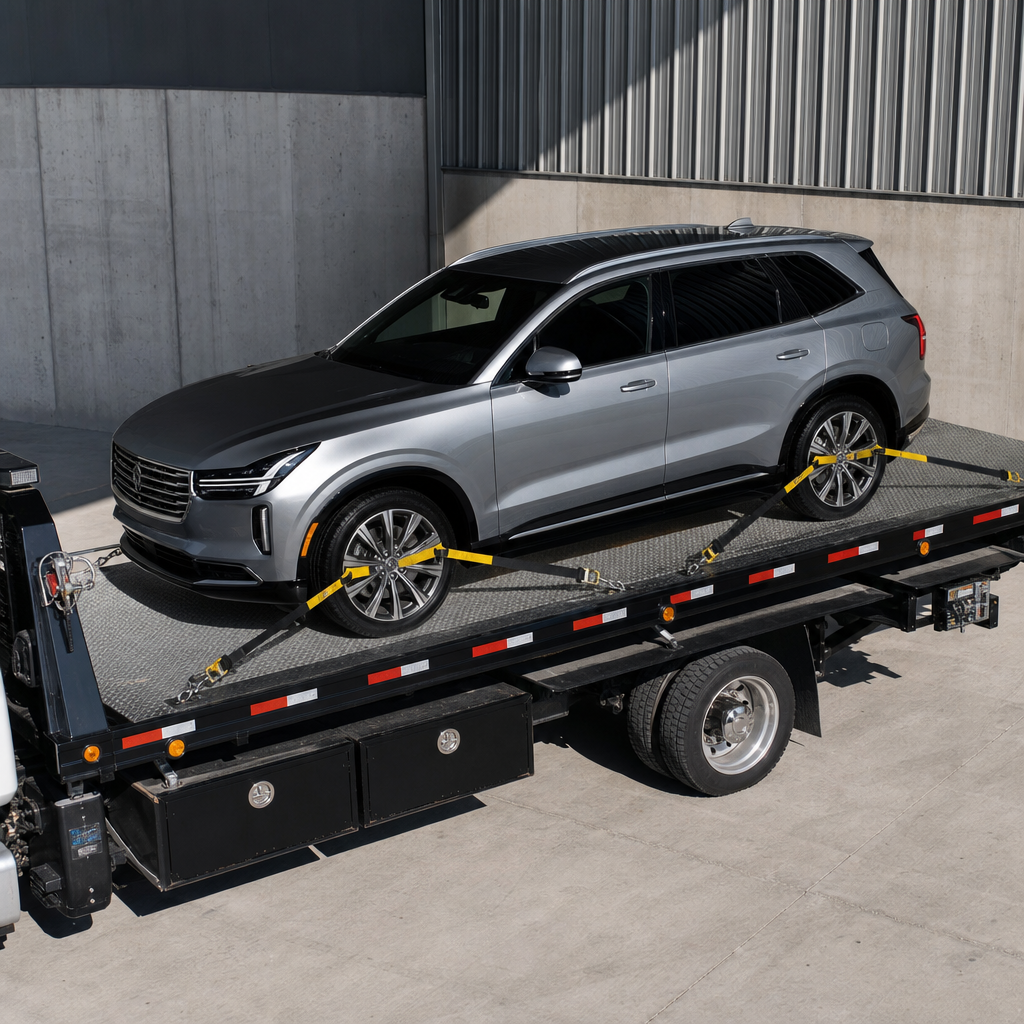

Tow-truck operators prepare a vehicle by identifying its drivetrain and hazards, checking the manufacturer’s transport procedure, choosing a loading method, isolating wheels that must not rotate, attaching approved securement equipment, and completing a final walk-around. A dispatcher can gather the facts needed to send suitable equipment, but the operator makes the final transport decision after inspecting the vehicle at pickup.
Risk signals to report before equipment is assigned
The first call is a hazard screen, not a final towing diagnosis. Tell dispatch what you can observe from a safe position. Do not crawl under the vehicle, touch loose wiring, open a hot hood, or inspect a damaged battery compartment.
| Visible or reported signal | What to do now | Why dispatch needs it |
|---|---|---|
| Smoke, flame, hissing, vapor, or rapidly increasing heat | Move well away and contact 911 or the fire department. Do not reapproach. | The scene must be made safe before towing can be considered. |
| Burning odor, unusual heat, EV or hybrid battery warning, or damage near the battery area | Shut down, exit, keep others away, and monitor only from a distance. If heat increases or smoke, vapor, or hissing begins, call emergency services immediately. | Possible high-voltage damage changes scene safety and transport procedures. |
| Fuel odor, spreading liquid, or a badly damaged underside | Avoid ignition sources and keep away from the liquid. Call emergency services if the leak creates an immediate danger. | The operator may need a different approach or may have to wait for the scene to be cleared. |
| Wheel folded inward, tire detached, steering locked, or vehicle unable to roll | Do not force the vehicle forward. | Dollies, skates, a winch, or another loading method may be needed. |
| Low bumper, body kit, long overhang, or underbody damage | Report where clearance appears limited. | Loading angle and ramp contact must be evaluated. |
| AWD, 4WD, EV, hybrid, or uncertain drivetrain | Share the year, make, model, and drivetrain if known. | Wheel rotation and transport requirements vary by manufacturer and configuration. |
Safe actions: how the operator prepares the vehicle
The exact sequence changes with the vehicle, its condition, and its manufacturer procedure. A typical preparation follows these checkpoints.
- Inspect the pickup area and vehicle. The operator checks traffic exposure, surface condition, overhead clearance, loading space, wheel position, leaking fluids, collision damage, ground clearance, and whether the vehicle can steer, brake, roll, and shift as expected.
- Confirm the transport procedure. Drivetrain labels, the owner’s manual, manufacturer guidance, and the vehicle’s actual condition help determine which wheels may roll. Dispatch information is preliminary; the operator may change the plan after this check.
- Position the tow truck. The truck needs a workable loading line and enough space for its equipment. In a garage, gated property, narrow parking area, or obstructed driveway, the operator may ask for access to be cleared before setup.
- Prepare steering, transmission, and parking controls. The operator follows the applicable procedure for shifting, steering release, parking-brake status, tow mode, or neutral access. Drivers should not force an electronic shifter or attempt improvised overrides.
- Protect wheels and driveline components. A flatbed can carry the vehicle with all wheels off the road. Other configurations may use wheel-lift equipment and dollies when permitted. For AWD and 4WD vehicles, the correct method depends on the owner’s manual or manufacturer transport instructions; no single setup is safe for every model.
- Control the loading angle. Ramps, approach position, winch line, skates, or cribbing may be used as appropriate to reduce contact with bumpers, underbody panels, or damaged wheels. A vehicle that cannot roll normally should not simply be dragged.
- Attach and load from approved points. The operator identifies suitable recovery or securement locations rather than attaching to suspension parts, steering components, trim, or high-voltage hardware. The winch controls movement onto the carrier; it is not the final cargo restraint.
- Secure the vehicle. Wheel straps, chains, or other rated equipment are applied according to the truck, vehicle, and transport method. Loose parts may need separate attention so they do not shift during travel.
- Complete final checks. The operator verifies alignment, strap placement, clearance, doors and compartments, steering position, and anything that could move or contact the truck. Securement is checked again before departure.
If your vehicle needs all-wheel-off-ground transport or has limited clearance, ask about flatbed towing. The request helps dispatch plan, but the operator still confirms the final method on scene.
Location details that make a West Palm Beach pickup easier to prepare
“West Palm Beach” alone may not identify the pickup point. Confirm whether the vehicle is physically in West Palm Beach or elsewhere in Palm Beach County, then provide:
- The street address, nearest cross street, and direction of travel, if applicable.
- A dropped location pin plus a written description; do not rely on the pin alone.
- Which side of the street, lot, or property contains the vehicle.
- The correct entrance for a parking area, building, gated property, or garage.
- Gate instructions and whether someone can provide access.
- Garage height restrictions, ramps, tight turns, or low overhead structures.
- Whether the vehicle is in a travel lane, on a shoulder, in standing water, on soft ground, or blocked by other vehicles.
- Current visibility at the vehicle. If heavy rain or darkness makes the pickup hard to see, say so and remain in the safest available location.
Traffic exposure and access can change how the operator positions equipment. Never stand in a lane to guide the truck or attempt to direct traffic yourself.
Avoidable mistakes that complicate transport
- Requesting equipment from drivetrain alone. “It is AWD, so it needs exactly this truck” skips manufacturer procedures, damage, clearance, and access. Give dispatch the facts and let the operator verify the method.
- Repeatedly trying to drive a damaged vehicle. A collapsed wheel, fluid loss, overheating, or severe vibration can worsen damage and create a larger hazard.
- Forcing neutral or releasing controls without guidance. Electronic shifters, parking brakes, and tow modes differ. Wait for operator instructions.
- Standing beside the vehicle during setup. Stay outside the loading path, winch line, and space between the vehicle and tow truck.
- Hiding access limitations. A low garage, locked gate, tight turn, or blocked lot can prevent the assigned truck from reaching the vehicle.
- Treating a tow truck as the first response to fire signs. Smoke, flame, hissing, vapor, or rapidly increasing heat requires distance and emergency responders before towing.
- Leaving out modifications or loose damage. Lowered suspension, aftermarket bodywork, hanging panels, and cargo can affect loading and securement.
Dispatcher decision checklist
Use this checklist when calling for emergency towing in West Palm Beach or Palm Beach County.
- People: Is everyone out of traffic and in a safe location?
- Emergency hazards: Is there fire, smoke, hissing, vapor, rapidly rising heat, or possible high-voltage damage? If yes, move away and call 911 or the fire department before arranging a tow.
- Exact location: City or Palm Beach County location, address, cross street, direction, side of property, entrance, and location pin.
- Access: Gate, garage clearance, narrow approach, blocked vehicle, soft ground, standing water, or traffic-lane exposure.
- Vehicle identity: Year, make, model, body type, drivetrain if known, and EV or hybrid status.
- Vehicle condition: Starts or does not start; shifts or does not shift; steering status; number of damaged wheels; fluid, odor, warning, or underbody concerns.
- Clearance and modifications: Low bodywork, long overhang, altered suspension, or loose panels.
- Destination: The exact delivery location and whether it will be open and accessible.
- Keys and occupants: Key availability, number of passengers, and any safe transportation arrangements needed.
If the vehicle is otherwise safe and only has a discharged battery, describe the warning lights and symptoms when requesting jump start service. If it is safely parked and simply out of fuel, state the fuel type when asking about fuel delivery. Do not request either roadside service when smoke, active leaking, collision damage, or escalating heat suggests a larger hazard.
Frequently asked questions
Does every AWD vehicle require the same towing setup?
No. Wheel-rotation limits differ by model and configuration. Dispatch should record that the vehicle is AWD, but the operator must confirm the owner’s manual or manufacturer transport procedure and inspect the vehicle before choosing flatbed, wheel-lift, or dolly use.
Why does the operator inspect the vehicle after dispatch already collected details?
Dispatch works from the caller’s preliminary description. The operator can directly assess damage, drivetrain information, clearance, wheel movement, manufacturer instructions, and access conditions. Those findings control the final loading and transport decision.
Can a vehicle with a locked wheel still be loaded?
Often, but it may require skates, dollies, controlled winching, or another technique. Report which wheel is affected and do not drag or force the vehicle before the operator arrives.
What should I do if an EV or hybrid starts hissing or smoking while I wait?
Move everyone well away immediately, avoid the vapor or smoke, do not touch the vehicle, and call 911 or the fire department. Do not return to retrieve items. Tell the towing dispatcher about the change only from a safe location, and do not arrange vehicle handling until emergency responders have cleared the scene.
Call only after the scene is safe
For a towing or roadside request, have the checklist ready and give dispatch your exact West Palm Beach or Palm Beach County location, vehicle details, hazards, and access conditions. If there is active fire, smoke, hissing, vapor, rapidly increasing heat, or suspected battery involvement, create distance and contact emergency services first.