
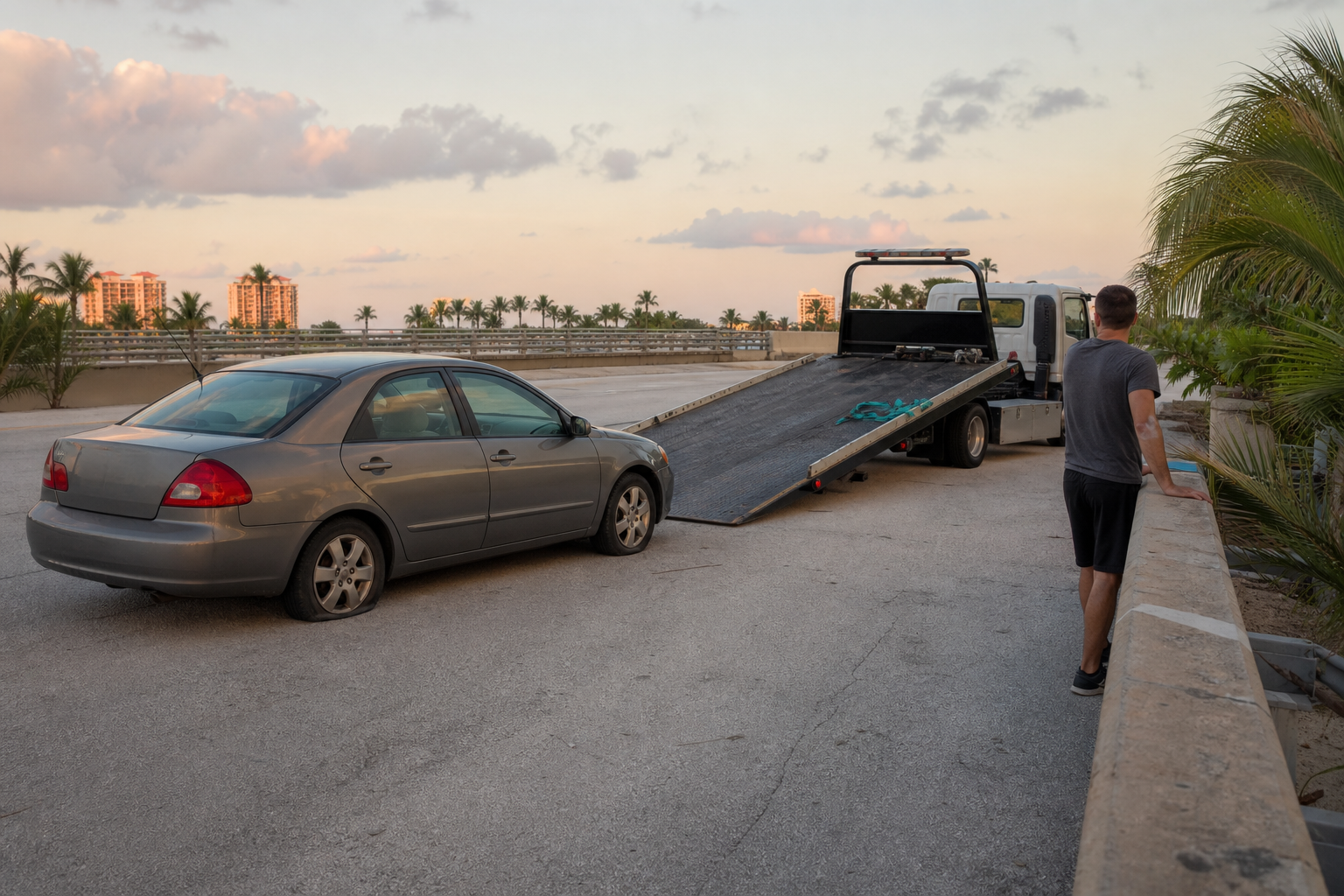
Choose the Right Help for a Heat-Stressed Vehicle in West Palm Beach
Use this decision rule: If the vehicle is overheating, a tire is damaged, or you see leaking or swollen battery parts, stop driving and request a tow. If the engine stays cool and the only symptom is a weak or silent start, a jump start may be the right first step.
Move out of active traffic only if the vehicle can reach a safer stopping place without being driven on a failing tire or with a hot engine. Turn on the hazard lights, note your exact vehicle location, and keep passengers away from traffic. Call emergency services if the stopped vehicle creates an immediate danger.
Risk Signals: Read What the Vehicle Is Telling You
Tires: heat can expose an existing weakness
Hot pavement and sustained driving add heat to a tire. Low pressure, overloading, impact damage, or worn rubber can make that heat more dangerous. A tire problem may appear as a pressure warning, new vibration, rhythmic thumping, pulling, or a sudden change in steering.
From a safe position, look for a visibly low tire, a sidewall bulge, cuts, separated tread, or exposed internal material. Do not touch the tire to judge its temperature. If the tire lost air rapidly or has visible structural damage, treat the vehicle as disabled.
Battery: a hot-weather failure may look like a starter problem
Heat speeds up battery deterioration. The warning may be slow cranking, clicking, dim interior lights, or no response when the key or start button is used. A battery can also fail with little warning after the vehicle has been parked.
Do not attempt a jump if the battery case is swollen, cracked, leaking, or giving off a sharp unusual odor. Smoke or heavy heat near the battery area also rules out a routine jump start. Keep clear and describe the condition to the dispatcher.
Cooling system: rising temperature means stop making heat
A high temperature gauge, temperature warning, steam, a sweet chemical odor, or fluid beneath the front of the vehicle can point to cooling-system trouble. Reduced power or rough operation may appear at the same time. Air conditioning that becomes warm by itself does not confirm overheating, so check the vehicle’s temperature display or warning lights.
If the temperature is rising, shut off the engine after reaching a safe stopping place. Do not continue toward a destination to see if the warning clears. A short additional drive can turn a roadside problem into greater engine damage.
Safe Actions: Stabilize the Scene Before Choosing a Service
If a tire starts failing while you are moving
- Hold the steering wheel firmly and ease off the accelerator.
- Avoid sudden braking or sharp steering.
- Let the vehicle slow while you look for a safer stopping area.
- Stop as far from moving traffic as the situation allows.
- Do not drive farther on a flat or visibly damaged tire.
If a safe tire change is not possible, request 24-hour towing. Tell the dispatcher which tire is affected, whether the wheel appears damaged, and whether the vehicle can roll or steer.
If the engine will not start
Turn off lights, climate controls, and accessories. Try one normal start attempt if you have not already done so. Repeated cranking can drain the remaining battery power and may hide useful symptoms.
A jump start service fits a vehicle that has normal tires, no overheating warning, no visible battery damage, and symptoms consistent with low battery power. Share whether you hear clicking, slow cranking, or silence. If the engine starts but warning lights remain, it stalls again, or the temperature rises, stop and arrange towing.
If the temperature warning appears
Turn off the air conditioning and move to a safer stopping place without pushing the vehicle farther than necessary. Shut off the engine. Keep the hood closed if steam is escaping, and allow the area to cool without leaning over it.
Never remove a hot radiator or coolant cap. Pressurized hot fluid can escape suddenly. Cooling-system trouble normally calls for towing rather than another attempt to drive.
Prepare a location a dispatcher can use
In West Palm Beach or elsewhere in Palm Beach County, a city name alone is not enough. Send a map pin or exact address when possible. State which entrance, side of the property, parking section, or travel direction applies.
Also report gates, garage clearance, narrow access, soft ground, or anything blocking a tow truck. Provide the vehicle year, make, model, color, drivetrain if known, tire condition, warning shown, pickup point, and intended destination. These details help the dispatcher distinguish roadside help from a tow and assess whether flatbed towing should be considered.
Avoidable Mistakes: What Not to Do in Extreme Heat
- Do not keep driving on a temperature warning. Stopping sooner is safer than trying to reach a familiar parking area.
- Do not open a hot cooling system. Waiting beside the vehicle does not make the cap safe to remove immediately.
- Do not test a damaged tire by kicking or pressing it. Inspect only from a safe position.
- Do not accept a jump without checking the battery case. Swelling, leaking, smoke, or a strong odor means the vehicle needs a different response.
- Do not stand between the disabled vehicle and moving traffic. Wait in a safer location and tell the dispatcher where you will meet the operator.
- Do not guess at your location. Confirm the map pin, address, access point, and vehicle description before ending the call.
- Do not assume every no-start is heat-related. If the fuel gauge is empty and there are no overheating or battery-damage signs, fuel delivery may be the more direct choice.
Decision Checklist: Jump, Tow, or Step Away?
Use these checks in order. Stop at the first condition that clearly applies.
- Is anyone exposed to moving traffic or another immediate hazard? Move people to a safer position if possible. Contact emergency services for an immediate danger.
- Is there steam, a high temperature warning, leaking coolant, or a rising gauge? Shut off the engine and choose I Need a Tow.
- Is a tire flat, bulging, separating, cut, or losing air quickly? Do not drive on it. Choose I Need a Tow unless a safe roadside tire solution is clearly available.
- Is the battery swollen, cracked, leaking, smoking, or unusually hot? Keep clear and request towing. Do not connect jumper cables.
- Does the vehicle only click, crank slowly, or stay electrically weak? With no other danger signs, choose My Car Won’t Start for jump start evaluation.
- Is the fuel gauge empty with no tire, battery, or cooling warning? Choose Bring Fuel.
- Could access affect the equipment? Report low clearance, a locked gate, tight parking, wheel damage, or a vehicle that cannot roll.
- Are the pickup point and destination ready? Confirm both before tow dispatch, along with a callback number and vehicle description.
Heat-Breakdown FAQs
Can I drive after the temperature warning turns off?
A cleared warning does not confirm that the cooling system is safe. If the gauge rose, steam appeared, or coolant may be leaking, keep the engine off and request a tow.
Should I request a jump start just because the car will not start on a hot day?
Not automatically. A jump is reasonable when the symptoms point to low battery power and the battery has no visible damage. Overheating, smoke, leaking, strong odor, or repeated stalling calls for a tow instead.
Does a tire-pressure warning always mean I need towing?
No. The correct response depends on air loss and visible condition. Rapid pressure loss, a flat tire, sidewall damage, tread separation, or an unsafe stopping location supports calling for roadside help or towing rather than continuing to drive.
What should I tell a West Palm Beach towing dispatcher first?
Start with safety and location: whether you are out of traffic, your map pin or exact address, and the correct access point. Then give the vehicle description, the warning or symptom, tire condition, whether it starts or rolls, and your destination if a tow is needed.
Choose Safety Before the Next Start Attempt
If the vehicle is hot, damaged, leaking, or unsafe to move, leave the engine off and select I Need a Tow. If it has a simple low-power no-start with no danger signs, select My Car Won’t Start. For any request, provide an accurate West Palm Beach or Palm Beach County location and explain access before help is dispatched.